
Stage 2: Build the English Your Professional Role Requires | The Expertise-to-Influence Framework
Actualizado: 31 jul
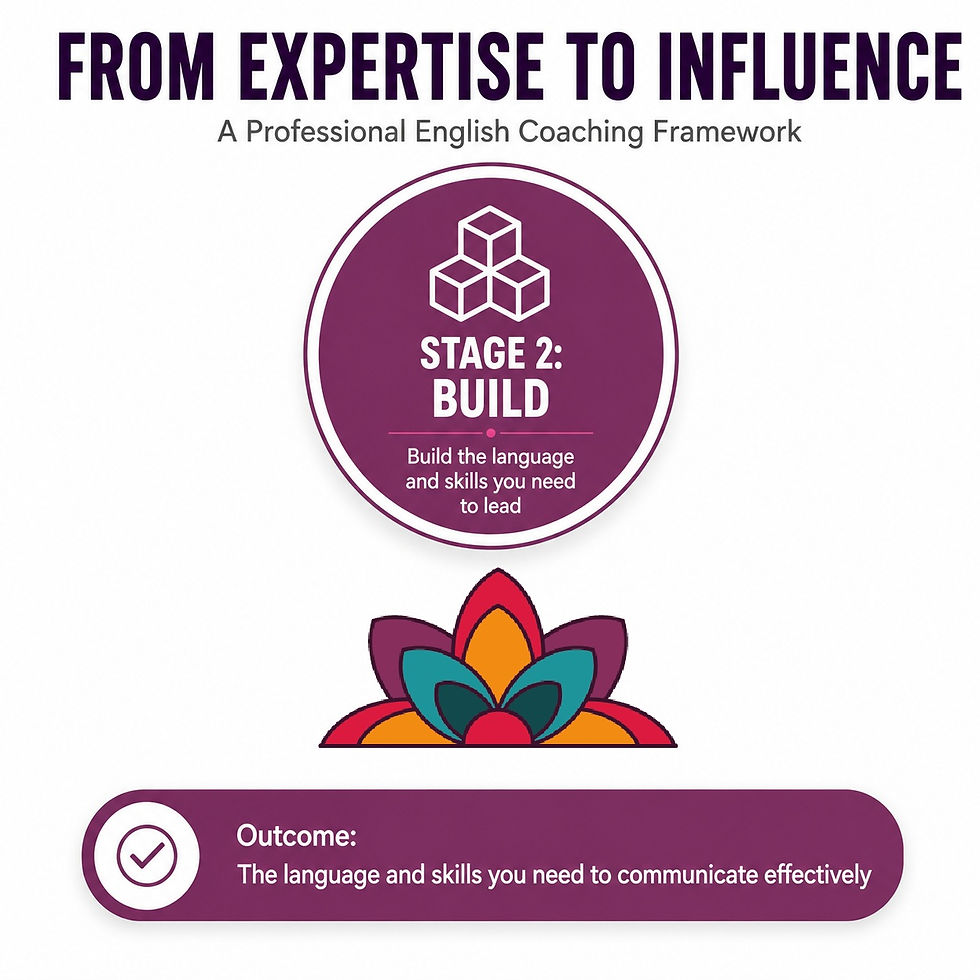
You already know how to think, lead and contribute in your first language.
The Build stage of the Expertise-to-Influence Framework focuses on developing the English that allows you to bring those professional strengths into the situations where they matter.
That may involve new vocabulary, but vocabulary alone is rarely enough. You may also need natural turns of phrase, clearer structures, greater control of tone and more flexible ways to express the same idea.
The purpose of this stage is to build the English your professional role requires, rather than accumulating vocabulary or memorizing one “correct” phrase for every situation. The language you develop should give you enough range to adapt your message to different people, relationships and workplace demands.
“What is the correct phrase?”
During Stage 1: Diagnose, a senior professional explained that she found it difficult to disagree in English meetings.
She knew what she thought. She could explain her reasoning clearly in her first language. What she wanted from me was the correct English phrase to use.
We began with a useful expression:
I can see the reasoning behind that approach. My concern is that...
It gave her a professional way to acknowledge the other person’s idea before introducing a different perspective.
But then we changed the situation.
What if she agreed with the objective but questioned one assumption? What if she needed to be more direct? What if she was speaking to a close colleague rather than a senior executive?
One phrase could not do all of that work.
Her realization was essentially this:
I do not need one perfect sentence. I need several ways to make the same professional move.
That is the purpose of the Build stage.
Build the English Your Professional Role Requires
At an advanced professional level, improving your English often means developing range.
You may need different ways to challenge an idea, ask for clarification, introduce a concern or recommend another course of action.
For example:
I agree with the overall objective, although I see the risk differently.
Could we examine one of the assumptions behind that conclusion?
I think we may need to consider another possibility.
Each expression performs a similar function, but the tone and level of directness are different.
The most appropriate choice depends on the relationship, the stakes and what you want the conversation to achieve.
That is why Professional English coaching cannot simply provide a script for every situation. Real conversations change. People interrupt, disagree, ask unexpected questions and respond in ways you cannot predict.
You need language you can adapt.
Language that supports your intention
The Build stage may focus on vocabulary, grammar, collocations and natural English phrasing. It may also include structures that help you organise a complex answer, guide an audience through a presentation or make your expectations clear.
The language must support your professional intention.
Giving feedback requires a different balance of clarity and diplomacy from challenging a proposal. Expressing empathy requires different language from leading a decision. Answering a difficult question requires both linguistic resources and a reliable structure for organizing your response.
You still provide the expertise, judgment and ideas.
The Build stage develops the English that helps you communicate them more precisely.
What happens after Build?
Learning useful language is important, but seeing it on a page does not mean you will be able to use it during a fast-moving meeting.
The next stages of the framework help you retrieve the language, rehearse realistic situations, refine your communication through focused feedback and transfer your developing skills into your professional life.
Build gives you the language and strategies you need. The rest of the framework helps make them usable when the situation is real.
You can explore all six stages in From Expertise to Influence: A Professional English Coaching Framework.
The framework begins with your existing professional strengths and helps you develop the English required to express them with greater clarity, confidence and influence.
Explore the other Professional English resources on this website, or book a free Strategy Call to discuss the workplace situations in which you would like your English to support you more effectively.
Make your English work for you!
Explore the Expertise-to-Influence Framework
Begin with the complete overview: From Expertise to Influence: A Professional English Coaching Framework.
Then explore each stage in practice:
🟢 Stage 2: Build — you are here


Comentarios